Case studyInfluencer operationsInternal tool
Nebula
A fragmented workflow,run as one system.
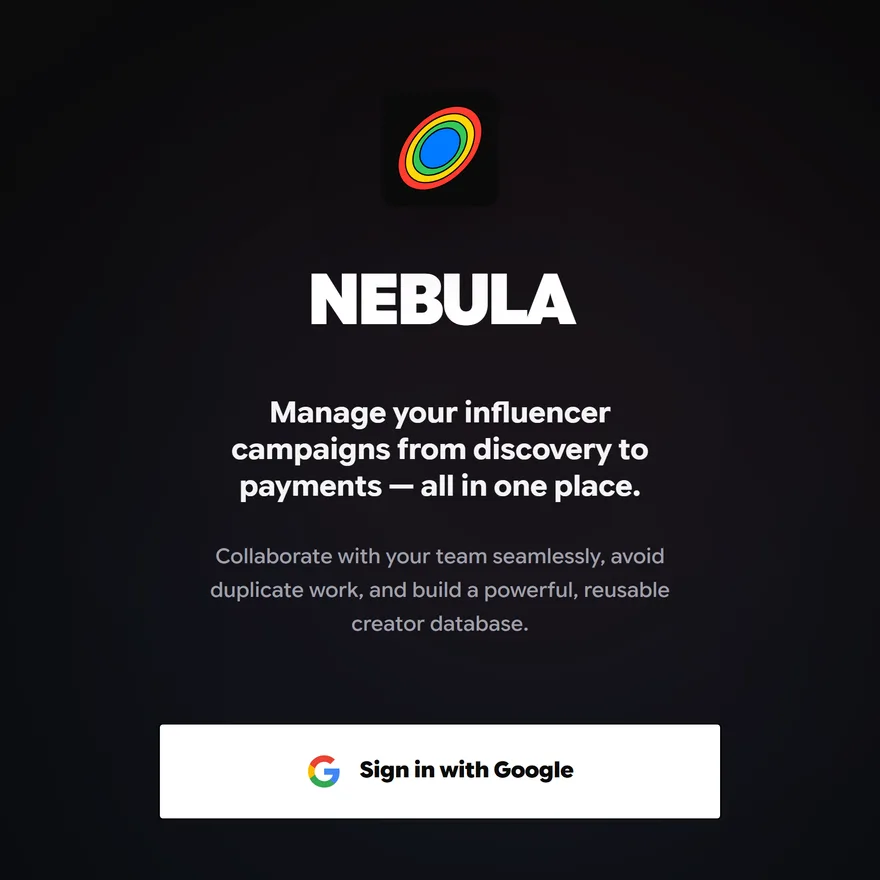
Influencer teams work across spreadsheets, creator databases, campaign trackers and payment records, so creators get duplicated and reconciliation turns into guesswork. Nebula centralises discovery, campaign execution, team performance and payment verification.
The business
Nebula is the internal operating system for an influencer marketing team. It was built for one company’s own operations, not sold as a product.
The problem
The team ran on spreadsheets. Creator lists in one, campaign trackers in another, payment records in a third, and a shared drive underneath all of it.
What it cost
The same creator was entered twice under two spellings. A campaign’s status depended on whoever had last updated the sheet. Reconciling what had been paid against what had been agreed was a manual exercise every month, and “have we worked with them before?” had no reliable answer.
What we found
Nothing was wrong with any one spreadsheet. The problem was that four of them held four halves of the same record, and none could be trusted on its own. What the team needed was a single place where a creator, a campaign and a payment are one object seen from three angles.
What we built
- A creator database that is the single record — discovery, history and rates in one entry
- Campaign execution tracked against that record, from brief to delivery
- Team performance visible per person and per campaign
- Payment verification reconciled against what the campaign actually agreed
What changed
Discovery, execution and payment run in one system. A creator is entered once, a campaign’s state is a fact rather than a recollection, and reconciliation is a view instead of a monthly exercise.
The pattern
Spreadsheets doing a database’s job. It is the most common operational problem there is: the sheet was right for the first year and is the bottleneck by the third.